What Happens at a Two-Week Anti-Wrinkle Treatment Review?
You have waited for the result to develop, resisted checking every expression in the mirror, and now your review appointment is approaching. What should actually happen when you return to the clinic?
A good review is not simply a quick look followed by more injections. It is a clinical assessment of how your face has responded, whether the agreed concern has improved, how the result looks in movement as well as at rest, and whether doing anything further would genuinely be helpful.
Around two weeks is often a useful time to assess facial anti-wrinkle treatment because the effect is usually much clearer than it was after only a few days. It is a practical checkpoint rather than a promise that every product, treatment area or patient reaches exactly the same stage on exactly the same day.
This guide explains what I look for at a review, how you can prepare, which questions are worth asking, and why the right outcome may be an adjustment, reassurance—or no further treatment at all.
I’m Dr Suresh Mohan, a GMC-registered medical doctor who assesses and treats patients at my Wimbledon clinic. This guide reflects the questions patients ask me after treatment and the calm, individual approach I use when reviewing a result.
People commonly use “Botox” as a familiar shorthand. Botulinum toxin is a prescription-only medicine, and any decision about treatment or a possible adjustment must be made for the individual patient after an appropriate assessment.
Your review at a glance
At a well-planned review, your practitioner should usually:
- ask how you have been since treatment and whether you had any concerns;
- compare your facial movement with the movement seen before treatment;
- look at balance and natural expression, not only whether lines are visible;
- check whether the agreed aim has been met rather than imposing a different idea of the “perfect” result;
- explain whether more time, observation or any adjustment is appropriate.
A review is an assessment—not an automatic top-up appointment.
Why Is a Botox Review Often Planned at Around Two Weeks?
The effect of botulinum toxin develops gradually. If you review the result too early, you may be judging a response that is still changing. One area—or one side—may appear to develop ahead of another, and the difference can become less noticeable as the result settles.
By around two weeks, facial movement and the degree of softening are often easier to assess. That gives the practitioner more useful information than a day-three or day-five mirror check.
This does not make day 14 a universal biological deadline. Licensed formulations and treatment areas do not all have identical onset and maximum-response timings. Your practitioner should interpret the result in the context of the medicine used, the area treated, the dose, your anatomy and the original plan.
If you are still waiting for your result to develop, read When Does Botox Kick In? for a realistic day-by-day guide.
Can a review happen earlier?
You can always contact the clinic earlier if you are worried or develop an unusual symptom. That is different from bringing forward a routine cosmetic assessment simply because the finished result is not visible yet.
An early conversation may provide reassurance, but it may still be too soon to decide whether any change to the treatment plan is appropriate.

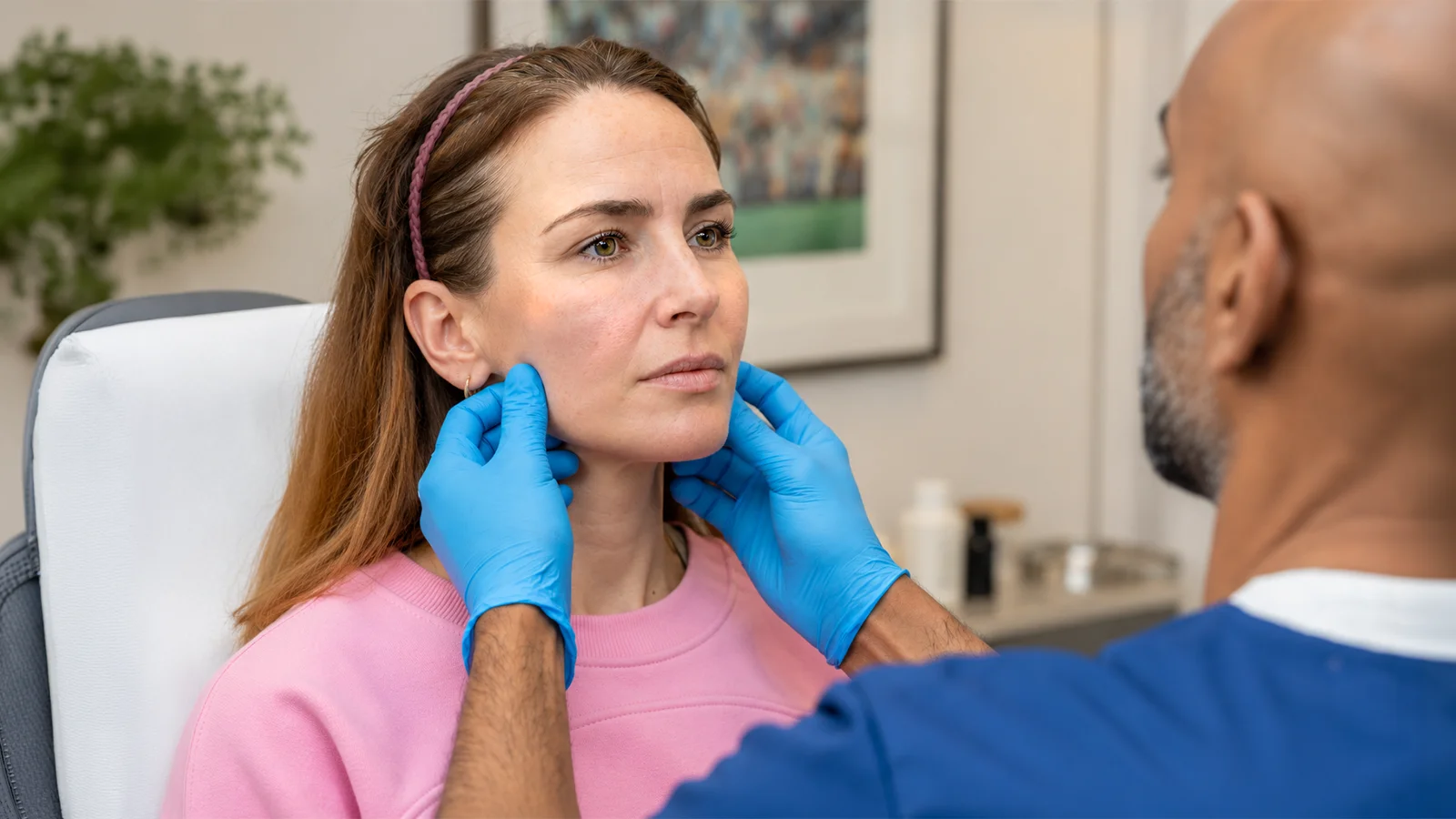
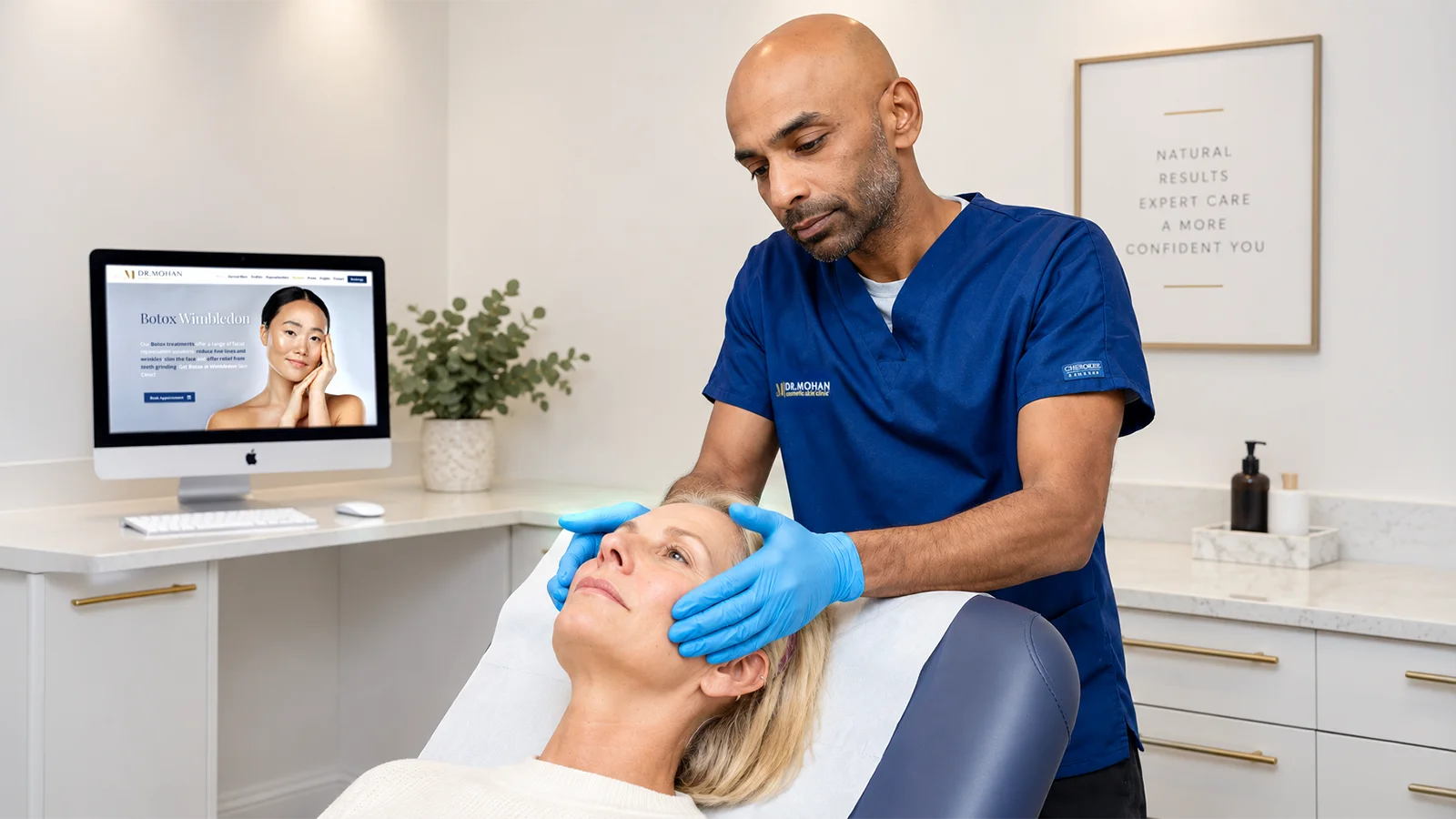
A good review begins with listening to how you feel about the result, then assessing the face at rest and in movement.
What Will Your Practitioner Check at the Review?
A thoughtful review should return to the reason you considered treatment in the first place. It is not only about counting lines or trying to remove every trace of movement.
Your face at rest and in movement
You may be asked to frown, raise your eyebrows, smile or make another expression relevant to the area treated. This helps the practitioner see how strongly the muscles are moving and whether the intended movement has softened.
The face should also be assessed at rest. A line visible without expression is partly a feature of the skin itself. Reducing muscle activity may help it look softer, but it may not disappear completely.
Balance between the two sides
Every face is naturally asymmetrical. The aim is not mathematical perfection; it is a result that appears balanced and appropriate for your own features. Your practitioner should consider both your natural starting point and any change since treatment.
Brow position and natural expression
Forehead and frown-line treatments influence muscles that work together. A review should consider brow position, eyelid area, forehead movement and how the result looks when you communicate—not just in one still photograph.
Whether the agreed concern has improved
The most important question is whether the original aim has been met in a way you are happy with. You may have wanted a softer frown while keeping expression, rather than a completely motionless forehead. The review should respect that choice.
How you felt after treatment
Tell the practitioner about any headache, bruising, tenderness, unusual sensation or other concern, even if it has settled. A clear history helps place the visible result in context.
Dr Mo’s approach to a review
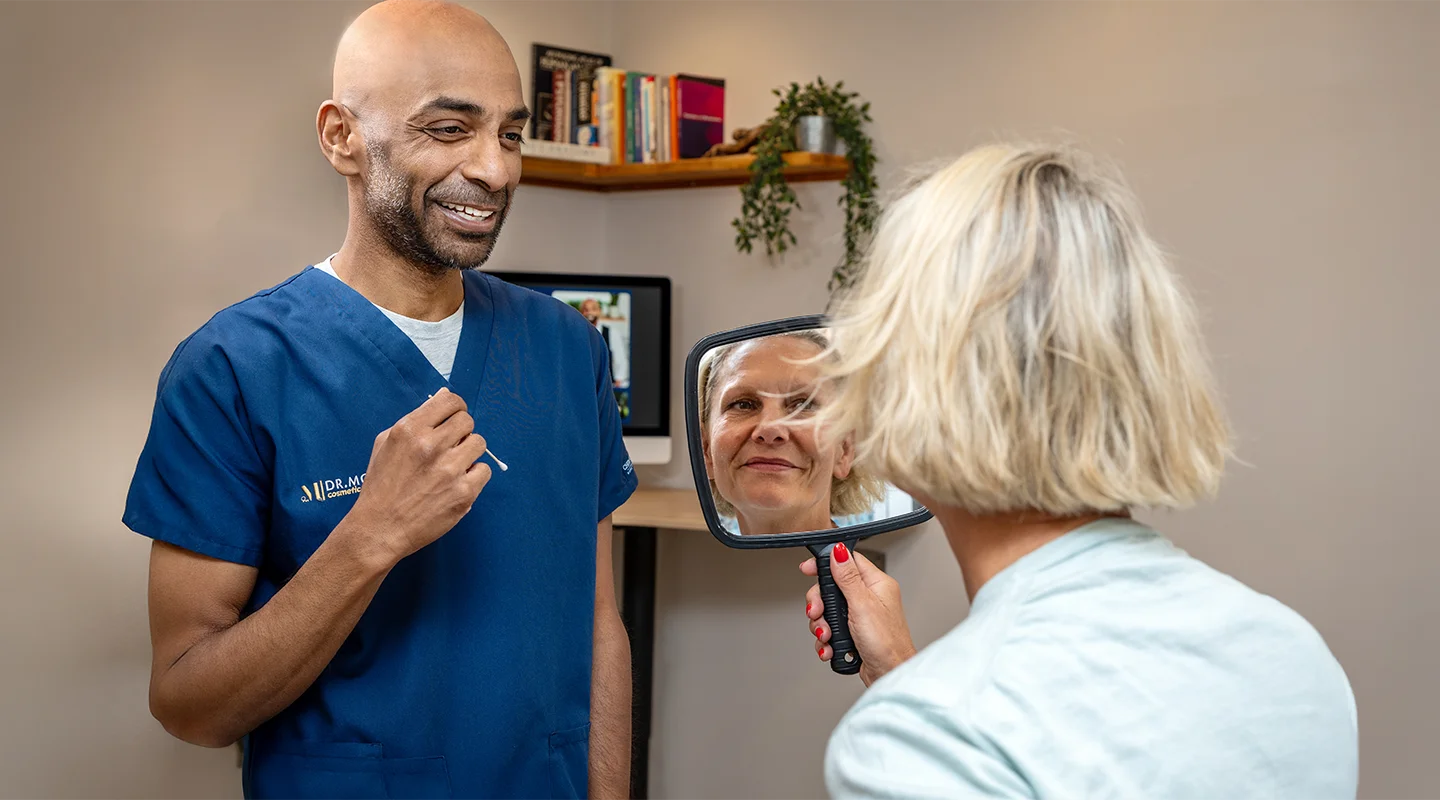
I do not begin a review with the assumption that more treatment is needed. I first listen to how you feel about the result, then assess your face at rest and in movement.
If the result is natural, balanced and has addressed the concern we discussed, leaving it alone may be the best decision. If something could reasonably be improved, I will explain the options, limitations and risks before any decision is made.
The purpose is not to sell more product. It is to make a considered clinical judgement and help you feel properly informed.

The purpose of a review is to assess the agreed result—not to assume that more treatment is needed.
How to Prepare for Your Two-Week Review
You do not need to rehearse or arrive with a list of faults. A few simple preparations can make the conversation more useful:
- Think back to your original goal. What did you hope would look or feel different?
- Note when you first noticed a change. An approximate day is enough.
- Bring consistent photographs if they help. Images taken in similar lighting, at rest and with the same expression, are more useful than unrelated selfies.
- Write down anything that worried you. Mention symptoms even if they have improved.
- Be honest about what you like as well as what you do not. This helps protect the parts of the result you want to keep.
- Bring your questions. You should understand the assessment before agreeing to any next step.
Do not stop prescribed medicines or change your usual medical care simply for a cosmetic review unless an appropriate clinician has specifically advised you to do so.
What If You Can Still Move After Two Weeks?
Some movement does not automatically mean the treatment has failed. It may be part of a deliberately natural result.
The question is whether the movement has changed in the way you and your practitioner intended. A forehead can still move while horizontal lines look softer. You may still be able to frown, but with less force. Lines beside the eyes may remain visible when you smile because preserving a genuine smile was part of the plan.
Complete immobility is not the only measure of success. For many patients, the better result is one that makes them look fresher or less tense while allowing them to remain recognisably themselves.
If there has been very little change, the practitioner should examine the area and consider the original dose, muscle strength, medicine used, treatment placement, static lines and individual response. The answer is not always “add more.”
What if a line is still visible?
A line created mainly by movement can soften as the muscle action reduces. A line already etched into the skin at rest may remain visible, even when the treatment has reduced the movement beneath it.
This distinction should be explained rather than treated as a reason to keep adding product. Skin quality, time, realistic expectations and—in some cases—a different treatment approach may all be relevant.
Does a Two-Week Review Mean You Will Get a Top-Up?
No. A review does not create an automatic entitlement or clinical need for more treatment.
Before any adjustment is considered, the practitioner should ask:
- Has the planned result had enough time to develop?
- Is there a genuine imbalance or an unmet part of the agreed treatment aim?
- Would an adjustment improve the result without creating a new problem?
- Is the concern actually a static skin line that more muscle relaxation will not remove?
- Would waiting or leaving a natural result alone be the safer choice?
If an adjustment is clinically appropriate, it should be explained and consented to as an individual decision. If it is not appropriate, a responsible practitioner should be comfortable saying no and explaining why.
Your clinic should make its review arrangements, timing and any applicable charges clear as part of the treatment plan. Policies vary, so ask before treatment rather than assuming every clinic works in the same way.
When Should You Contact the Clinic Before the Review?
You do not need to wait for the planned appointment if something is worrying you. Contact the treating clinic promptly if a symptom is unusual, worsening or not following the Botox aftercare guidance you were given.
Seek prompt medical advice if you develop severe or worsening symptoms, visual changes, difficulty swallowing or breathing, or concerns about your general health. Use urgent or emergency services when the situation requires them.
For common questions about mild headaches after treatment, you can also read Can Botox Cause Headaches? General information online cannot assess an individual symptom.
Useful Questions to Ask at Your Review
You do not need to ask every question on this list. Choose the ones that help you understand your own result:
- Has my response developed as you expected?
- Is the remaining movement intentional?
- Is the line I can still see caused by movement, or is it present at rest?
- Does the result look balanced when I move my face?
- Would an adjustment genuinely improve anything?
- What could happen if we add more?
- Would waiting be the better option?
- What should I remember for a future treatment plan?
A good practitioner should welcome sensible questions and explain the reasoning behind the recommendation.
What Happens After the Review?
If no adjustment is needed, you can simply allow the result to continue naturally. Botulinum toxin is temporary, and muscle movement returns gradually rather than switching back on overnight.
Your practitioner may suggest keeping a note of when you first noticed the effect, when it felt most settled and when movement began to return. That information can help make a future consultation more personal and precise.
Do not rush into another appointment at the first sign of movement. A maintenance plan should consider how long your result lasted, how you felt about it, the treatment area, your medical history and whether you still want treatment.
If you are thinking about taking a break, What Happens If You Stop Botox? explains what to expect without alarm or pressure.

A two-week review is an opportunity to assess the result, discuss any concerns and decide whether any adjustment is appropriate.
Frequently Asked Questions About Two-Week Botox Reviews
Why do I need to wait two weeks for a Botox review?
The effect develops gradually, so a very early appointment may assess a result that is still changing. Around two weeks often gives a clearer view of movement, balance and softening, although exact timing varies by product, area and individual response.
Can I contact the clinic before two weeks?
Yes. Contact the clinic whenever you are worried or something feels unusual. The clinic may be able to advise you earlier even if it remains too soon to judge the finished cosmetic result.
Does a review automatically include more Botox?
No. A review is an assessment. Any adjustment must be clinically appropriate for your face, response and agreed aim. Sometimes reassurance, more time or leaving a natural result alone is the better decision.
Is it normal to still have facial movement at the review?
Yes. Preserving appropriate expression may be part of the treatment plan. The practitioner should assess whether the movement has softened as intended and whether the result looks balanced—not simply whether the area is completely still.
What if one eyebrow looks different from the other?
Faces are naturally asymmetrical, and small differences can be more noticeable while treatment is developing. At the review, the practitioner should compare your current movement with your natural starting point before deciding whether any action is appropriate.
Why is a line still visible even though the muscle moves less?
A line present at rest is partly within the skin, not only the muscle movement underneath it. Reducing repeated folding may soften it, but more muscle relaxation does not guarantee that an established line will disappear.
Should I bring photographs to the review?
They can help if they show the same expression in similar lighting, especially if you noticed a change on a particular day. Your practitioner’s pre-treatment photographs and in-person movement assessment remain important.
Is a two-week review always free?
Review policies and charges vary between clinics. The arrangements should be explained as part of your treatment plan, so check with the clinic rather than assuming that every provider uses the same policy.
Considering Anti-Wrinkle Treatment in Wimbledon?
If you are considering treatment and want an honest discussion about what would suit your face, you are welcome to book an initial consultation.
At my doctor-led aesthetic clinic in Wimbledon, the initial consultation is free. I will listen to what you would like to improve, assess your facial movement, explain the realistic options and tell you if I think another approach—or no treatment—would suit you better.
There is no pressure to decide on the spot. The aim is for you to understand the treatment, likely timeline, review plan and limitations before you choose whether to proceed.
You can explore my anti-wrinkle treatment service in Wimbledon or read Dr Mohan Clinic patient reviews.
Prefer to speak first? Call 07702 389 636 or use the enquiry form below.
Warm regards,
Dr Suresh Mohan

Ask Dr Mohan a Question
If you would like help deciding whether a consultation is worthwhile, send a short message. Please do not include sensitive medical information in the website form; we can discuss relevant details privately.
By clicking ‘Send enquiry‘ you agree to Dr Mohan Clinic’s Privacy Notice.
Evidence and Further Reading
This guide presents the two-week review as a practical clinical checkpoint rather than a universal deadline. Product information, treatment indications and individual responses differ. Useful UK sources include:
Medical note: This article provides general educational information and cannot assess an individual treatment result or replace medical advice. Botulinum toxin is a prescription-only medicine. Suitability, dose, treatment area, expected response, review timing and any adjustment must be decided for the individual patient by an appropriately qualified prescriber.