Polynucleotides under eyes are a natural, non-filler option for tired-looking under-eyes caused by thin, crepey or ageing skin.
If your under-eye area looks tired, crepey, slightly dark or less fresh than it used to, polynucleotides may offer a natural way to improve skin quality without adding volume.
Updated: April 2026 — Doctor-led guide from Dr Suresh Mohan (GMC-registered), Wimbledon.
A practical guide to polynucleotides under the eyes, covering dark circles, crepey skin, treatment suitability, recovery, and what kind of improvement is realistic.
At my Wimbledon aesthetic clinic, I use polynucleotides treatment as a skin-quality treatment for the delicate under-eye area. They are not there to “fill” hollows in the way tear trough filler does. Instead, Polynucleotides are used to support the skin itself — helping improve texture, hydration and overall tissue quality over time.
Current reviews in aesthetic medicine describe polynucleotides as a promising regenerative treatment for skin rejuvenation, with reported benefits in fine lines, elasticity and skin texture.
For the right patient, this can mean smoother, fresher, healthier-looking under-eyes with a natural result that still looks like you.
Do Polynucleotides Under the Eyes Work?
Polynucleotides under the eyes are mainly a skin-quality treatment, not a volume treatment.
This treatment is often most useful for crepey under-eye skin, fine lines, mild translucency and a tired-looking eye area.
It is usually less effective for deep hollows, strong pigmentation or prominent eye bags.
What are polynucleotides under the eyes?
Polynucleotides treatment is a regenerative injectable approach used in aesthetic medicine to improve skin quality and support tissue repair. In the under-eye area, they are commonly chosen because the skin here is naturally thin and often shows ageing early.
Rather than creating instant volume, polynucleotides are used to support a gradual improvement in hydration, elasticity, texture and fine lines. That is why I think of them as a natural-looking under-eye rejuvenation treatment, not a quick fix. Recent reviews describe them as a promising option in aesthetic medicine.

Polynucleotides support under-eye skin quality over time.
What can polynucleotides under the eyes help with?
Polynucleotides are most useful when the main problem is skin quality.
They may help with:
- crepey under-eye skin
- fine lines under the eyes
- thin, delicate under-eye skin
- mild darkening made worse by translucency
- a tired-looking under-eye area
- patients who want a non-filler approach
If your concern is mainly that the under-eye skin looks thinner, more lined or more fragile than it used to, this is often where polynucleotides fit best.
Who This Treatment Suits
You may be a good candidate if:
- your under-eyes look tired rather than deeply hollow
- the skin looks thin, crepey or finely lined
- you want subtle, natural-looking improvement
- you are cautious about filler
- you understand that results are gradual, not instant
Do polynucleotides work for dark circles?
Sometimes — but it depends on what is actually causing the darkness.
“Dark circles” are not one single problem. Medical reviews show that under-eye darkness can come from a mixture of factors, including thin translucent skin, visible vessels, pigmentation, tear trough hollowing, puffiness and shadowing from anatomy. Because of that, the right treatment depends on the cause.
So the honest answer is this:
Polynucleotides can help some under-eye concerns, but they do not fix every kind of dark circle.
They tend to make the most sense where the area looks tired because the skin is thin, crepey or ageing. They are less likely to give a dramatic result if the main issue is pigment, a deep hollow, or true eye bags.

Polynucleotides may help dark circles linked to thin, tired-looking under-eye skin.
What polynucleotides under the eyes do not fix well
This is one of the most important things to understand before booking treatment.
Polynucleotides are usually not the best answer for:
- significant tear trough hollowing
- prominent eye bags
- strong hereditary pigmentation
- heavy shadowing from anatomy
- marked lower-lid laxity
- patients wanting an instant filler-style change
The under-eye area is complex, and treatment should be matched to the anatomy rather than sold as a universal fix. Under-eye concerns often need a more tailored approach because different causes respond to different treatments.
When Another Treatment May Be Better
Polynucleotides do not replace lost volume in the way filler does.
If your main concern is a deep hollow or a structural shadow, another treatment may be more suitable.
Polynucleotides under eyes vs tear trough filler
This is one of the biggest questions patients ask — and the simplest way to explain it is this:
Polynucleotides are better for skin quality. Tear trough filler is better for replacing volume.
They are not direct substitutes in every patient.
| Concern | Polynucleotides under eyes | Tear trough filler |
|---|---|---|
| Main aim | Improve skin quality | Replace lost volume |
| Best for | Crepey skin, fine lines, thin skin, subtle rejuvenation | True hollowness in suitable patients |
| Result style | Gradual and natural | More immediate structural change |
| Recovery | Mild swelling, redness, bruising possible | Can also swell or bruise; more technically sensitive area |
| Best patient mindset | “I want fresher-looking skin” | “I want hollowing corrected” |
Filler can absolutely still be the right treatment in selected patients. But the under-eye area is delicate, and patients increasingly ask about non-filler alternatives because they want to avoid a puffy or overfilled look. If you are comparing options more broadly, you may also find my guide on which injectable treatment is right for you helpful.
Skin vs Volume
Polynucleotides are mainly for skin. Fillers are mainly for volume.
In some patients they are alternatives. In others, they solve completely different problems.

Illustrative image used to explain the difference between skin quality and volume loss. Polynucleotides support skin quality, while tear trough filler may be used to replace volume where appropriate.
Do polynucleotides help crepey skin under the eyes?
Yes — polynucleotides can help crepey skin under the eyes, and this is one of the clearest reasons to consider them.
Crepey under-eye skin is usually a skin-quality issue, not a volume issue. Current reviews of polynucleotides suggest they may improve wrinkles, hydration, texture and elasticity, which is exactly why they are often discussed for delicate areas such as the under-eyes.
If your main concern is that the skin under the eyes looks thinner, more lined or less resilient, polynucleotides often make much more sense than chasing volume.
Polynucleotides under eyes before and after: what kind of result is realistic?
This treatment works best when expectations are realistic.
The best “before and after” result is usually that the under-eye area looks healthier, smoother and less tired — not obviously treated.
The best under-eye results with polynucleotides are usually:
- smoother-looking skin
- softer crepiness
- better hydration
- a fresher, less tired appearance
- subtle improvement rather than dramatic change
What you should not expect
- an instant “done” look
- complete removal of deep hollows
- complete removal of hereditary dark circles
- a total fix for eye bags
The current evidence supports promising but gradual improvements in skin quality. It does not support presenting polynucleotides as a miracle fix for every under-eye concern.
How many sessions of polynucleotides under the eyes are usually needed?
Most patients should think in terms of a course, not a one-off treatment.
Polynucleotides are commonly used over a series of sessions rather than judged after a single appointment.
In practical terms, most patients should expect:
- an initial course
- appointments spaced over time
- review of how the skin responds
- maintenance later if needed
That is a much healthier expectation than assuming one session will do everything.
How long does it take to see results from polynucleotides under the eyes?
Polynucleotides work gradually over time.
They do not behave like filler, so the improvement is not judged by what you see immediately after injections. First the area settles, and then the skin improves over the following weeks. Expect gradual improvement rather than an instant structural effect.
A simple way to think about it
- immediately after: recovery stage
- first few days: swelling and bumps settle
- following weeks: skin begins to look smoother and fresher
- after a course: best time to judge overall change
What do eyes look like immediately after polynucleotides?
Straight after treatment, it is common to see:
- small raised bumps at injection points
- puffiness or swelling
- redness
- occasional bruising
The under-eye area is delicate, so even mild swelling can look surprisingly noticeable. Side effects are generally mild and transient, but the early settling phase can still be visually dramatic for some patients.
The key point is this:
“Immediately after” is not the result. It is the recovery phase.
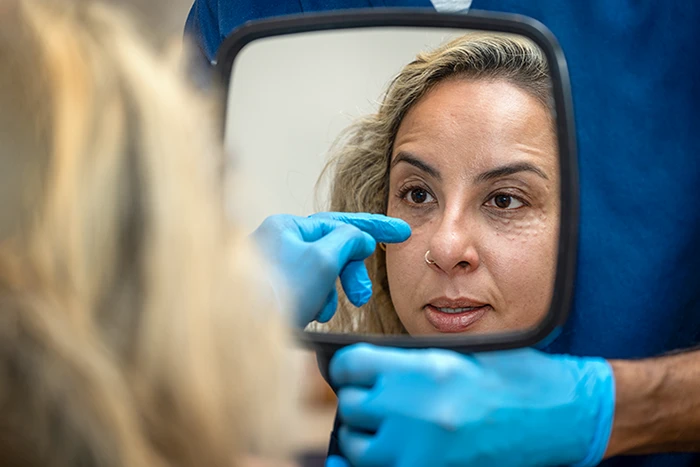
A patient checks the treated under-eye area in a mirror immediately after polynucleotide treatment at Dr Mohan Clinic. Small post-treatment marks are normal and usually settle quickly.
What to Expect Immediately After
It is normal to see:
- small bumps
- puffiness
- mild redness
- occasional bruising
The under-eye area can look temporarily worse before it looks better.
Polynucleotides under eyes swelling, bruising and downtime
Most patients do not have major medical downtime, but they may still have social downtime.
Common short-term effects
- swelling
- bruising
- tenderness
- visible injection points
Practical advice:
It is wise not to book under-eye treatment immediately before:
- weddings
- parties
- important work meetings
- professional photographs
- travel where you want to look your best
Polynucleotides are usually well tolerated, with side effects typically mild and short-lived, but under-eye swelling can still be very noticeable while the area settles.
When to contact the clinic
Mild swelling and bruising can be normal.
Please contact the clinic promptly if swelling is worsening rather than settling, the area becomes increasingly red or hot, or anything feels unusual. You may also find the NHS advice before having a cosmetic procedure helpful before deciding on treatment.
Results and recovery timeline
| When | What to expect |
|---|---|
| Immediately after | Small bumps, puffiness, redness, sometimes bruising |
| First 24–72 hours | Swelling starts to settle |
| First couple of weeks | Early improvement becomes easier to judge |
| After a course | Best point to assess overall change |

Mild swelling and bruising can happen before the area settles.
Polynucleotides Under Eyes FAQs
Here are answers to some of the most common questions about polynucleotides under the eyes, including results, downtime, swelling, suitability and what to expect after treatment.
Do polynucleotides under the eyes work?
Yes, they can work very well when the main issue is skin quality rather than deep volume loss. They are most often used to improve thin, crepey under-eye skin, fine lines and a generally tired-looking eye area. The results are usually subtle and natural rather than dramatic.
Are polynucleotides better than fillers?
Not always — they are simply better for different concerns. Polynucleotides are mainly used to improve skin quality, while fillers are mainly used to restore volume and structure. The right choice depends on whether your under-eye area looks more tired because of thin skin or because of hollowness.
How long does it take to see results?
This is a gradual treatment, so results are not judged straight after injections. The area needs time to settle first, and improvement is usually assessed over the following weeks. Most patients notice the best change after a course rather than after one appointment.
How long do polynucleotides last under the eyes?
This varies from person to person and depends on the treatment plan, product used and starting condition of the skin. Some patients enjoy results for longer than others, especially after a full course. It is best to think in terms of improvement over time rather than a fixed “one-size-fits-all” duration.
Can polynucleotides get rid of eye bags?
Not reliably. If the main concern is true eye bags or significant puffiness, polynucleotides are usually not the best treatment. They tend to work better for skin quality concerns such as crepey texture, fine lines and mild tired-looking change.

Polynucleotides are usually better for skin quality than true eye bags.
Can polynucleotides cause eye bags?
They can cause temporary puffiness or swelling after treatment, especially in the first few days. That is not the same as creating permanent eye bags. In most cases, this early swelling settles as the area recovers.
What do eyes look like immediately after treatment?
It is common to see small bumps, swelling, redness and sometimes bruising straight after treatment. Because the under-eye area is delicate, even mild swelling can look quite noticeable at first. This is part of the early recovery phase, not the final result.
Do polynucleotides help crepey skin under the eyes?
Yes — this is one of the clearest reasons to use them. Polynucleotides are often chosen for under-eyes that look thin, finely lined, crepey or less smooth than before. The goal is to improve skin quality and create a fresher, healthier appearance over time.
How many sessions are usually needed?
Most patients should expect a course of treatment rather than a one-off appointment. The exact plan varies depending on the product used and the condition of the under-eye skin. This is usually the best way to achieve a more noticeable and lasting improvement.
What should I avoid after treatment?
Follow your personalised aftercare carefully, especially in the first day or two. It is also helpful to read my full Polynucleotides Aftercare Guide, which covers swelling, exercise, heat, skincare actives and what is normal after treatment. Good aftercare can make the recovery period much easier and more predictable.

Doctor-led under-eye treatment at Dr Mohan Clinic in Wimbledon.
Polynucleotides under eyes in Wimbledon
If you are looking for polynucleotides under eyes in Wimbledon, the most important step is a proper consultation.
At my clinic, I always look at why the under-eye area looks tired before recommending treatment. As a GMC-registered medical doctor, I take a careful and honest approach to the under-eye area, where the cause of tired-looking eyes is not always the same.
For some patients, polynucleotides are an excellent non-filler option. For others, the main issue is hollowness, puffiness, pigment or anatomy, in which case a different approach may be better.
If you would like to check current treatment fees before booking, you can also view polynucleotides prices online.
If you are based in Wimbledon, Raynes Park, Kingston, Richmond, Putney, Surbiton or nearby South-West London, you are very welcome to book a consultation to talk things through in person.
Book your free consultation here →
Or call me directly: 07702 389 636
Warm regards,
Dr Suresh Mohan
Contact Dr Suresh Mohan
Considering Polynucleotides Under Eyes in Wimbledon? My clinic is dedicated to providing this advanced skin rejuvenation technique, ensuring top-notch care in the heart of London.
If you have a specific question, want to book a free consultation or request a call back, please fill in the form below, and I will get back to you as soon as possible.
By clicking ‘Send enquiry‘ you agree to Dr Mohan Clinic’s Privacy Notice.