If you have been researching polynucleotide treatments, one of the next questions that usually comes up is how many sessions you actually need. It is a very sensible thing to ask, because this is not usually a treatment that is judged after a single appointment in the same way people sometimes think about filler or Botox.
The way I usually explain it to patients is this: most people are best treated as a course rather than a one-off session. In many cases, that means 3 sessions, usually spaced a few weeks apart. In delicate areas such as the under-eyes, it can sometimes be 4 sessions, depending on the skin and what we are trying to improve.
For the right patient, that still feels very manageable. Polynucleotides are often chosen by people who want gradual, natural-looking improvement in skin quality rather than something that looks obviously “done”. That slower, more elegant style of treatment is exactly why the number of sessions matters.
Updated: April 2026 — Doctor-led guide from Dr Suresh Mohan (GMC-registered), Wimbledon.
A practical guide to how many polynucleotide sessions are usually recommended, how far apart they are, when under-eyes may need a slightly different plan, and when maintenance may be worth considering.
Quick answer
- Most patients start with 3 sessions.
- Sessions are usually spaced 2 to 4 weeks apart.
- Under-eyes often need a slightly more gradual course, sometimes 3 to 4 sessions.
- Maintenance is then considered later, often months afterwards, rather than immediately.

Most patients begin with 3 polynucleotide sessions, spaced a few weeks apart, to allow the skin to improve gradually and naturally.
Why a course is usually recommended
One reason this question matters so much is that polynucleotides work gradually. Patients often choose them because they want their skin to look fresher, healthier, smoother, and better supported, but still very natural. That sort of change usually builds over time, which is why I think it is much more helpful to describe polynucleotides as a treatment plan rather than a one-off quick fix.
In practice, patients often come for polynucleotides because they would like help with things such as:
- crepey skin
- fine lines
- dull or tired-looking skin
- loss of freshness
- delicate under-eye skin
- overall skin quality rather than added volume
That is why one session may start the process, but a course is usually the fairest way to judge the treatment properly. It gives the skin time to respond and gives the result a much better chance to show itself clearly.
Key takeaway
One session may begin the process. A course is usually the better way to judge the treatment properly.
The usual treatment plan
If you are looking for the clearest practical answer, this is the sort of plan I would usually describe:
- Face or general skin quality: often 2 to 3 sessions
- Under-eyes: often 3 to 4 sessions
- Spacing between sessions: usually 2 to 4 weeks apart
- Maintenance: often discussed months later, depending on how well the skin is holding the result
You will sometimes see slightly different numbers online, and that is normal. Some brands describe 2 to 3 treatments per area, while practitioner guidance for delicate periocular skin often talks about 3 to 4 sessions for a fuller result. Dr Mohan’s current polynucleotides page also describes a 3-treatment course spaced 2 to 3 weeks apart, followed by later maintenance.
What can change the number of sessions you need?
The number is not really about chasing a magic figure. It is more about matching the treatment plan to the patient in front of you.
The main things that can influence the number of sessions are:
- the treatment area
- how thin, dry, crepey, or tired the skin looks at the start
- whether the goal is general skin quality or a more delicate area such as under-eyes
- how your skin responds after the first sessions
- the exact product and protocol being used
So although 2 to 3 sessions is a very good general guide, I would not present it as a rigid rule for every face and every treatment area. It is much better to assess properly, plan clearly, and then review how the skin is responding as the course progresses.
| Factor | Why it can affect the plan |
|---|---|
| Treatment area | Delicate areas such as the under-eyes are often treated with slightly different protocols |
| Starting skin quality | Skin that is thinner, crepier, or more visibly tired may need the fuller course before the result can be judged properly |
| Your goals | A subtle “freshening” goal may be different from trying to improve more established texture or laxity issues |
| Product protocol | Different brands and practitioner protocols are not always identical |
| How your skin responds | Some patients notice early change quickly, while others need more time and a fuller course |
Under-eyes usually need a slightly different mindset
The under-eye area is one of the places where polynucleotides can be especially appealing, but it is also one of the areas where patients need the clearest expectations.
When I am discussing under-eye treatment, I usually explain that the goal is often to improve skin quality, crepiness, fine lines, and overall freshness in a delicate area. It is not about creating obvious volume or instantly changing deeper hollows in one session. That is one reason under-eye protocols are often described more gradually, sometimes as 3 to 4 sessions rather than simply one or two.
That does not make the treatment less worthwhile. In fact, it is often the opposite. It simply means the area rewards patience, careful planning, and a more realistic treatment journey.

The under-eye area is delicate, so polynucleotide treatment usually needs a careful, gradual approach with realistic expectations.
How far apart should polynucleotide sessions be?
In most cases, the spacing is around 2 to 4 weeks apart. That is the most practical and commonly repeated guidance. Some product instructions lean closer to 2 weeks, while broader practitioner guidance often gives a 2 to 4 week range. Dr Mohan’s own current treatment page describes 3 treatments 2 to 3 weeks apart for maximal effect.
For patients, the key point is simple: the sessions should be close enough together to work as a course, but not rushed into one blur of appointments. The spacing is there to let the skin respond steadily while keeping the plan coherent.
How I usually explain the treatment journey in clinic
The easiest way to understand polynucleotide sessions is to think of them in stages:
Session one — starting the process
The first session begins the regenerative process. Some patients notice an early change in hydration or freshness, but it is usually too early at this point to decide what the final result will look like.
Session two — building the result
This is often the point where the treatment starts to feel more meaningful. The skin is beginning to respond, and the overall plan starts to make more sense. For many patients, this is where the value of doing a course becomes clearer.
Session three — consolidating the improvement
A third session is often what helps the result feel more settled and complete. This is one reason why three sessions is such a common clinical pattern, especially for people wanting a fuller skin-quality result rather than a very minimal refresh.
Session four — selected cases, especially under-eyes
A fourth session is not the default for everyone, but it is often mentioned in under-eye protocols and other more delicate treatment plans where gradual improvement matters.
What happens after the first course?
Once the initial course is complete, I think it is much more helpful to talk about review and maintenance than endless repeat appointments.
Official Ameela guidance describes follow-up treatment at around 6 to 8 months, while Dr Mohan’s current polynucleotides page describes one treatment every 6 months to maintain the result after the initial course. In real life, the right timing depends on the treatment area, the quality of the skin, and how much of the improvement the patient would like to keep.
That sort of approach usually feels much more comfortable for patients. It turns polynucleotides into a thoughtful skin-quality plan rather than something that feels open-ended or excessive.
Think of it this way
Course first. Review second. Maintenance later if it is genuinely worth doing.
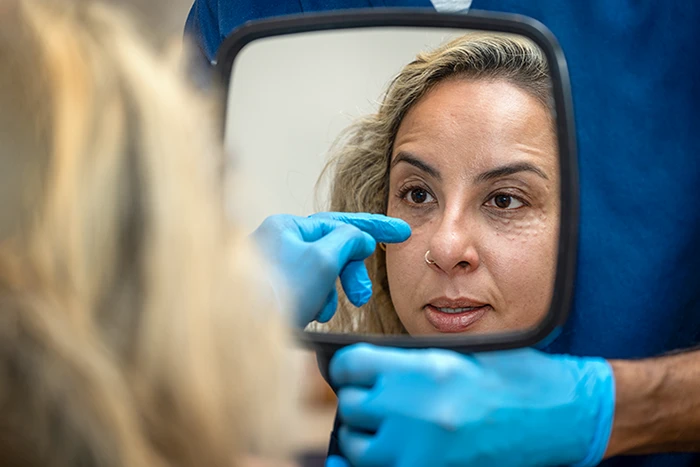
A patient checks the treated under-eye area in a mirror immediately after polynucleotide treatment at Dr Mohan Clinic. Small post-treatment marks are normal and usually settle quickly.
Is it always exactly three sessions?
Not always. Three sessions is a very common and very useful guide, but I would rather explain it as a likely starting course than pretend there is one fixed number that suits absolutely everybody.
For some patients, 2 sessions may be enough for a lighter treatment plan. For others, especially around the under-eyes, 3 to 4 sessions may make more sense. The most natural way to explain it is simply that most people start with 2 to 3, and some delicate areas need a little more patience.
Common Questions About Polynucleotides
Polynucleotides are often described as regenerative or skin-rejuvenating treatments. Many patients still have practical questions, though. They want to know what the treatment can really do, how quickly it works, and whether it is right for concerns such as under-eye ageing or tired-looking skin. Here are some of the questions people ask most often.
How far apart should polynucleotide sessions be?
In most cases, polynucleotide sessions are spaced 2 to 4 weeks apart. That gives the skin time to settle and respond properly. It also keeps the course close enough together to work well.
The exact timing can vary a little. It depends on the area being treated and the treatment plan. For most patients, though, this is the sort of spacing I would usually discuss during consultation.
What changes should I expect after each session?
The changes are usually gradual rather than dramatic. After the first session, some patients notice better hydration, a fresher look, or slightly smoother skin. The treatment often becomes easier to appreciate after the later sessions.
As the course progresses, the skin can start to look healthier, calmer, and better supported. This is especially true in areas with texture changes, crepiness, or a tired look. If you would like a clearer idea of the treatment journey, it is worth reading Polynucleotides Before and After: What Changes Can You Expect?
What should I avoid after each polynucleotide session?
After treatment, it is usually sensible to avoid anything that may irritate the skin or increase swelling unnecessarily. This matters most during the first day or two. That often includes intense exercise, excessive heat, alcohol on the same day, and touching the area too much straight after treatment.
You will always be given clear aftercare advice at the clinic, but if you would like a full step-by-step guide, you can read Complete Guide to Polynucleotides Aftercare
Are polynucleotides suitable for under-eyes?
Yes — polynucleotides can be a very good option for the under-eye area. They are often chosen when the concern is crepey skin, fine lines, or skin that looks tired and less fresh. They are not usually aimed at obvious volume loss.
The under-eye area is delicate. Treatment there usually needs a careful and gradual approach, with realistic expectations about what the treatment is designed to improve. If that is your main concern, it is worth reading Polynucleotides Under Eyes for Dark Circles and Crepey Skin

The under-eye area needs a careful, gradual approach. Polynucleotides may help improve skin quality where the concern is crepey skin, fine lines, or tired-looking eyes.
How do polynucleotides compare with Botox, Profhilo, and fillers?
They do different jobs, which is why the best treatment depends on what you are trying to improve. Botox is usually chosen for movement-related lines, fillers for structure or volume, Profhilo for hydration and skin quality, and polynucleotides for a more regenerative, skin-repair-focused approach.
That is why consultation matters so much. The right treatment is not about choosing the “best” one in general, but the one that best fits your skin, your concerns, and your goals. For a clearer comparison, read Botox, Profhilo, Fillers & Polynucleotides: Find Your Best Fit
How much do polynucleotides cost?
The cost depends on the treatment area, the product used, and whether you are having a single session or a course. In practice, most patients are better thinking in terms of the full treatment plan rather than the price of one isolated appointment.
If you would like more background first, you can read What Are Polynucleotides? Benefits, Results, Downtime & Cost. If you are ready to check current pricing, you can also view the price list on the clinic website.
Are polynucleotides better than Botox?
That depends entirely on what you want the treatment to do. Polynucleotides and Botox are not really direct alternatives in the usual sense, because they are used for different reasons. Botox is mainly used to soften expression lines caused by muscle movement, while polynucleotides are usually chosen to improve skin quality, hydration, and tissue support.
So rather than asking which one is better in general, it is usually more helpful to ask which one is better for your particular concern. If you are comparing the two, you will soon be able to read Are Polynucleotides Better Than Botox?
Related reading:
If you are planning treatment, these guides may also help:
– Polynucleotides in Wimbledon
– How long do polynucleotide injections last?
– Polynucleotides under eyes
– Complete guide to polynucleotides aftercare
Polynucleotides in Wimbledon
If you are considering polynucleotides in Wimbledon, one of the most helpful things you can do is look beyond the headline promise of the treatment and think carefully about what you want it to improve.
When patients come to see me, the conversation is usually not just about how long the treatment lasts. It is also about:
- what is bothering you most
- whether the concern is mainly skin quality, tired-looking skin, crepey texture, or something else
- what kind of result is realistic
- whether polynucleotides are the right treatment for your skin and your goals
- whether a course of treatment and future maintenance would make sense for you

Doctor-led assessment and realistic treatment planning are central to natural-looking aesthetic results.
At my clinic, I take a careful, conservative, doctor-led approach because the best results usually come from good assessment, appropriate treatment choice, and realistic expectations. Polynucleotides can be an excellent option for the right patient, especially when the goal is healthier, fresher, better-quality skin that still looks natural.
If you are considering the polynucleotides treatment in Wimbledon, you may also like to look at my polynucleotide treatment prices and read some of the Dr Mohan clinic reviews before booking.
If you are based in Wimbledon, Raynes Park, Kingston, Richmond, Putney, Surbiton or nearby South-West London, you are very welcome to book a consultation to talk things through in person.
Book your free consultation here →
Or call me directly: 07702 389 636
Warm regards,
Dr Suresh Mohan
Contact Dr Suresh Mohan
Considering polynucleotides in Wimbledon?
For questions, free consultations or call back requests, please fill in the form below and I will get back to you as soon as possible.
By clicking ‘Send enquiry‘ you agree to Dr Mohan Clinic’s Privacy Notice.